

The Icosahedron
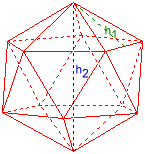
The surface of an Icosahedron consists of twenty equilateral triangles and is therefore one of the five Platonic solids.
The following elements of a Icosahedron are calculated if one of them is given:
- Edge a
- Apothem h1
- Altitude h2
- Circumradius ru
- Inradius ri
- Volume V
- Surface S
Example 1:
Given:
¯¯¯¯¯
         Apothem h1 = 1,5

Results:
¯¯¯¯¯¯¯
                Edge a = 1,7320508
           Altitude h2 = 3,2945564
   Circumradius rc = 1,6472782
            Inradius ri = 1,309017
             Volume V = 11,33642
            Surface S = 25,980762
Example 2:
Given:
¯¯¯¯¯
                Edge a = sqrt(3)

Results:
¯¯¯¯¯¯¯
         Apothem h1 = 1,5
           Altitude h2 = 3,2945564
   Circumradius rc = 1,6472782
            Inradius ri = 1,309017
             Volume V = 11,33642
            Surface S = 25,980762
See also:
Graphics 3DWikipedia: Platonic solid